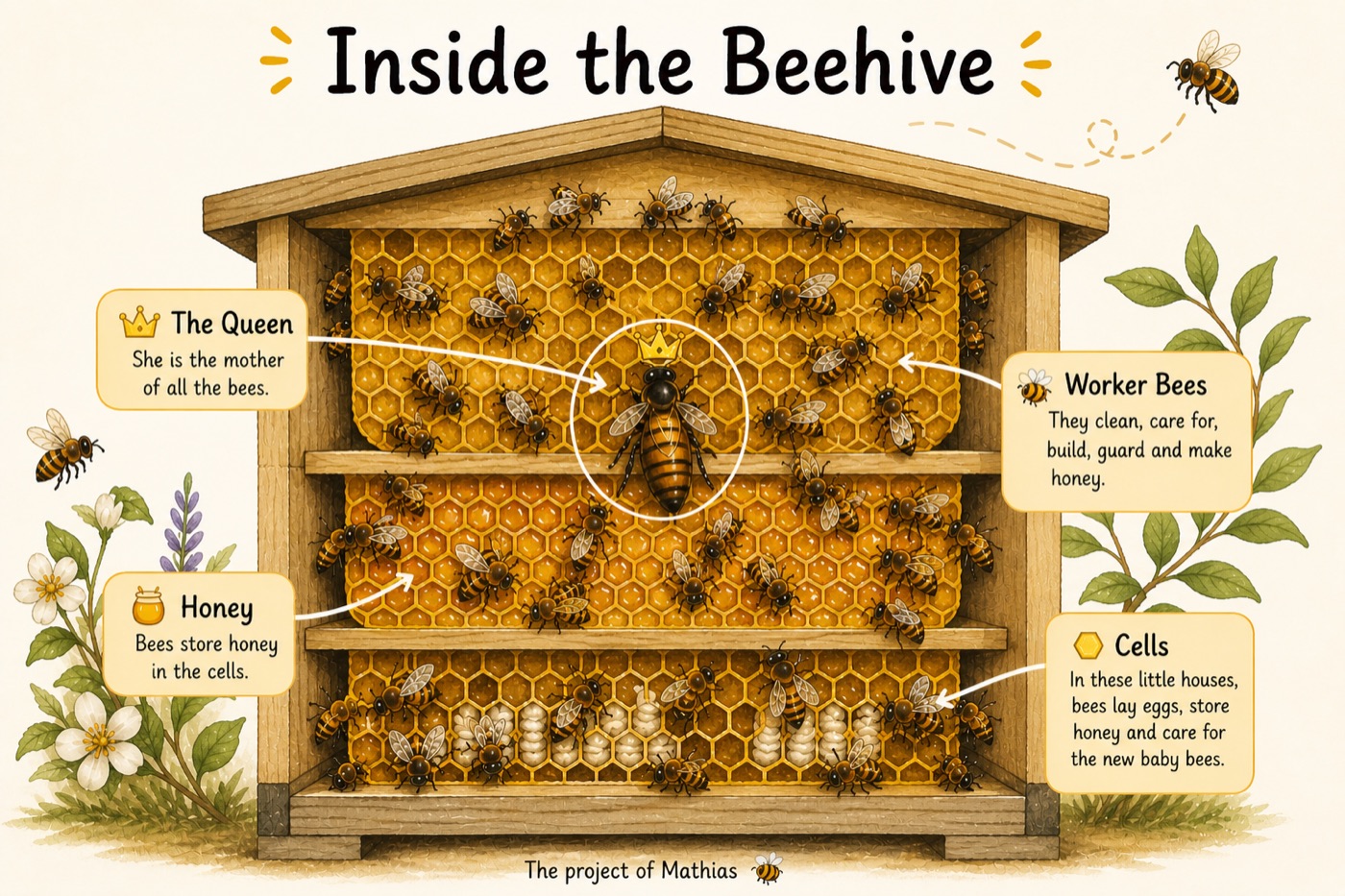
Let me show you what the bees' house looks like from within:
who leads, who works, and why they build their rooms in such
a curious shape.
🐝 By Mathias📖 Slow reading🌻 La Canalosa, in May
The first time we opened a beehive, I did not know where to look.
There were thousands of bees, each one doing something different.
It took me days to begin to understand. This is the first part
of what I have learned.
A hive is not a heap of bees living together. It is one very big
family, where every single one has a job. And when they all do
their work, the hive moves like one body. The beekeeper said this
to me first; the more I look, the more I believe it.
Look closely: the queen wears a crown, the workers move around her, and every golden cell keeps the honey safe.
Three kinds of bees
Three kinds of bees live in the hive, and once you know what to
look for, you can tell them apart easily:
The queen — she is the mother of all of them. She lays the eggs. She is longer than the others and is always surrounded by workers who take care of her.
The workers — they do almost everything: cleaning, feeding the babies, building, gathering nectar, making the honey. All of them are female.
The drones — these are the males. They are bigger and rounder. Their only job is to look for queens from other hives.
There is only one queen in the whole hive. If she dies, the bees
notice straight away — in about fifteen minutes — and they begin
to raise a new one. I think that is one of the most extraordinary
things in the world.
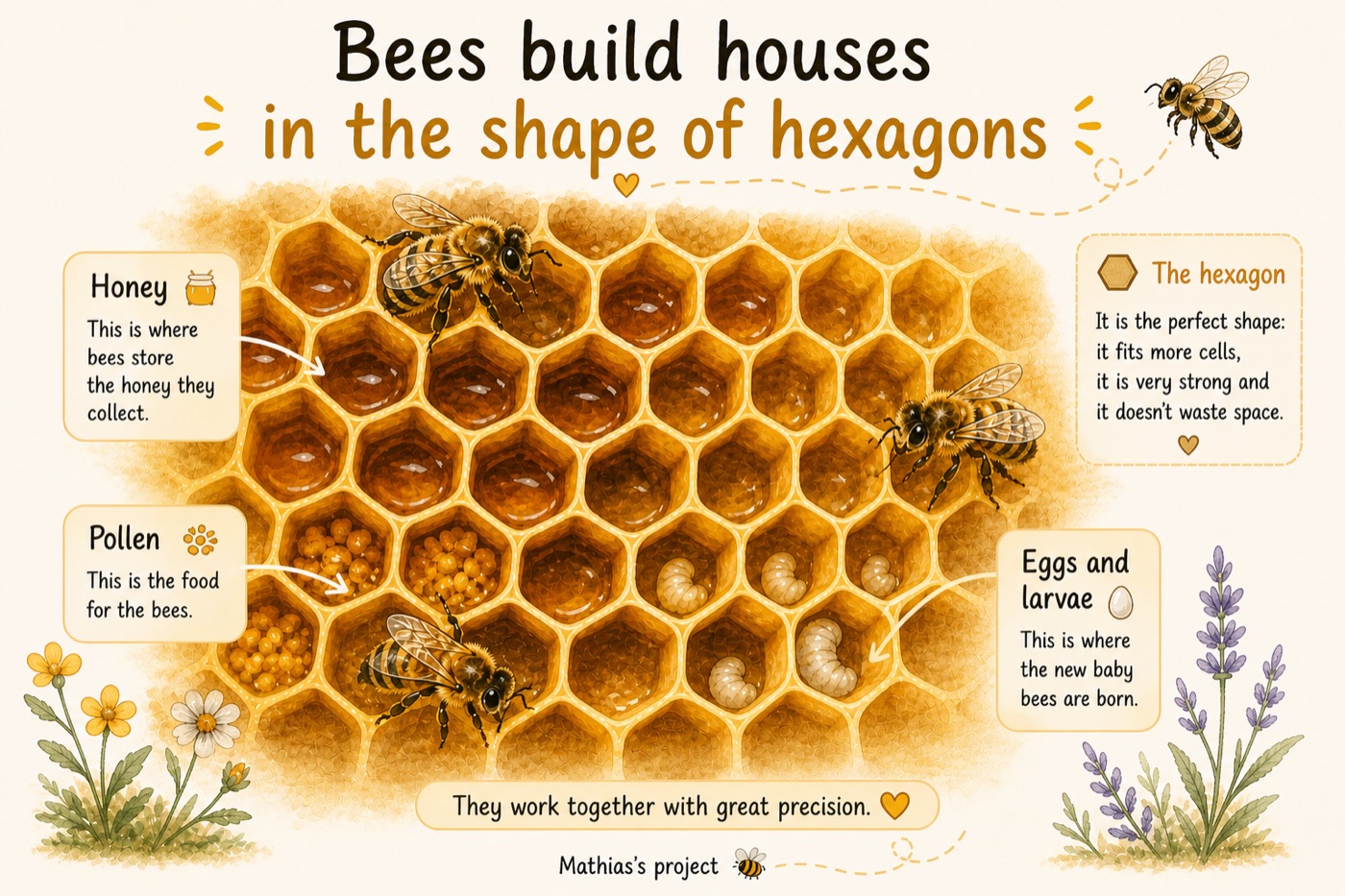
The perfect hexagon
The little rooms where the eggs grow, where the honey is stored,
and where the pollen is kept are all made of wax. And they all
have the same shape: six sides. A hexagon.
Why? Because the hexagon is the most perfect shape. More cells fit
into less space, they are very strong, and not a single drop of
wax is wasted. The bees did not choose this shape — the wax falls
into hexagons by itself, when many round cells are pressed
together. It is mathematics, made by tiny creatures who do not
know they are doing it.
Each cell holds something different: honey, pollen, or an egg that will soon become a bee.
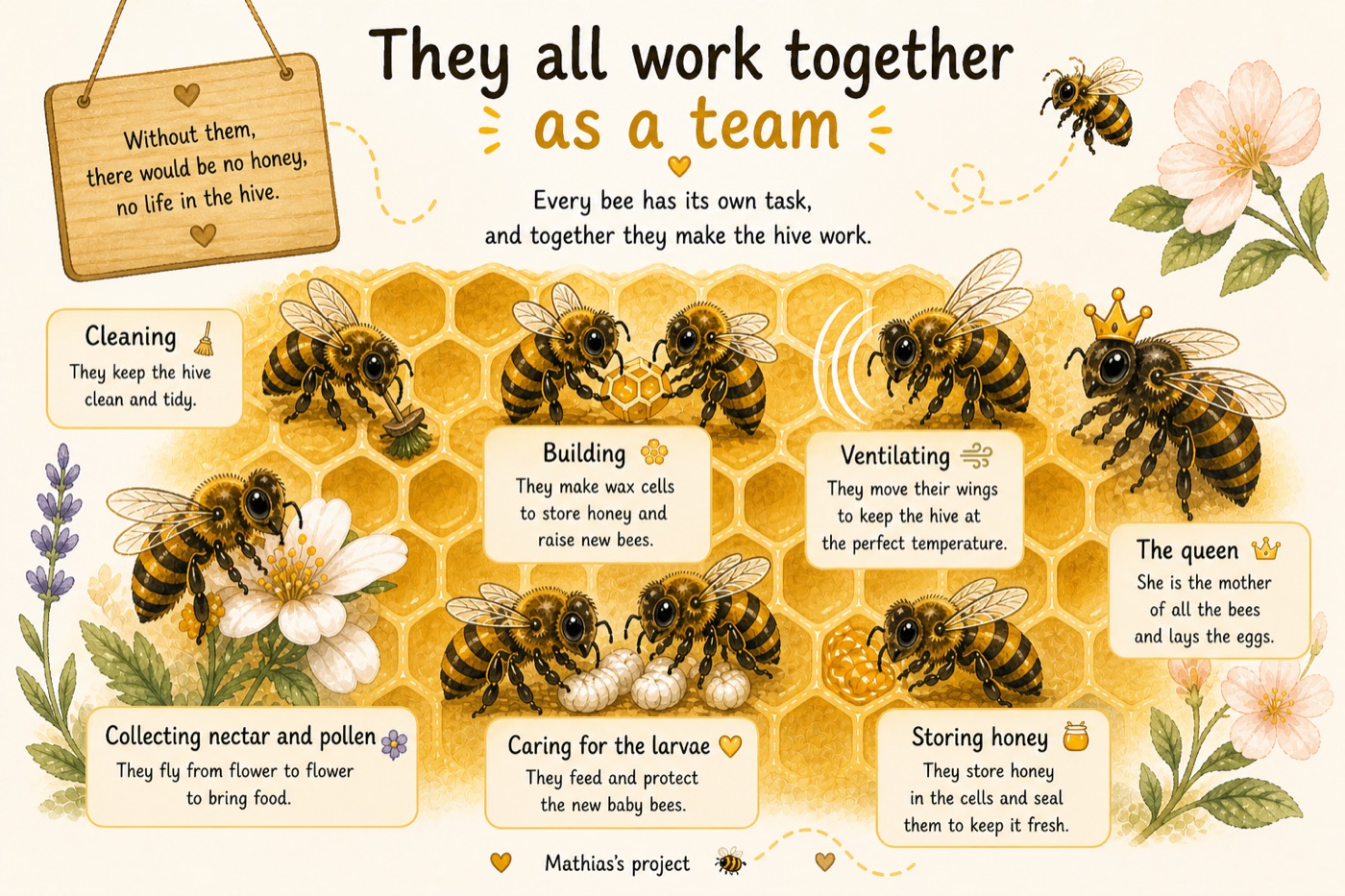
Every bee has her task
The thing I love most about the bees is that nobody gives them
orders. No one tells one bee to do this and another to do that.
And still, they all know what to do at any moment. They take turns
according to their age: when they are newly born, they clean the
cells; a little older, they feed the babies; then they build wax;
and finally, they fly out to look for flowers. After six weeks
of work, they die.
A single bee, in her whole life, makes only one small spoonful
of honey. Which means each jar holds the work of thousands.
Without the workers there would be no honey, and no hive at all. They all work together.
This is what surprises me the most: they do not need a leader.
Each bee knows what she has to do, and together they make things
that no single bee could ever make alone. A little like us in
class, when we build a mural together — only the bees never
get tired, and they never fight.
That is why caring for a hive is not like caring for an animal.
It is more like caring for a forest, or a river: you listen for
what is needed, and give only what they ask for. They know better
than we do.
Questions people ask me
How many bees live in a single hive?
In summer, between 40,000 and 60,000 bees. One queen, a few drones, and a great many worker bees. In winter, the numbers fall — so the cluster can keep itself warm together.
What does the queen do?
The queen is the mother of every bee in the hive. She lays the eggs — up to two thousand a day in spring. She is the only queen, and the rest of the bees take care of her and protect her.
Why are the cells shaped like hexagons?
Because the hexagon is the most efficient shape: more cells fit into less space, they are very strong, and not a single drop of wax is wasted. The bees do not choose this shape — it happens on its own, when many round wax cells are pressed together.
Do bees sleep?
Yes, mostly at night. The foragers, who have flown far during the day, sleep more deeply. The young bees who stay inside the hive only nap, here and there.
Is it dangerous to visit a hive?
Not with a proper suit, on a quiet day, and always with an adult who knows what they are doing. I always go with someone wise. The first time, we only stood nearby and listened — opening the hive came later.