From a tiny wildflower in the field, to a great jar on your kitchen
table. The journey is long, slow, and full of small wings.
🐝 By Mathias📖 Five sweet steps🌻 La Canalosa, in June
When I open a jar of honey now, I never look at it the same way.
I know there are hundreds of tiny journeys inside: one bee, one
flower, one drop, then another bee, another flower, another drop.
It is like a story with very many characters — and every spoonful
holds a small piece of summer.
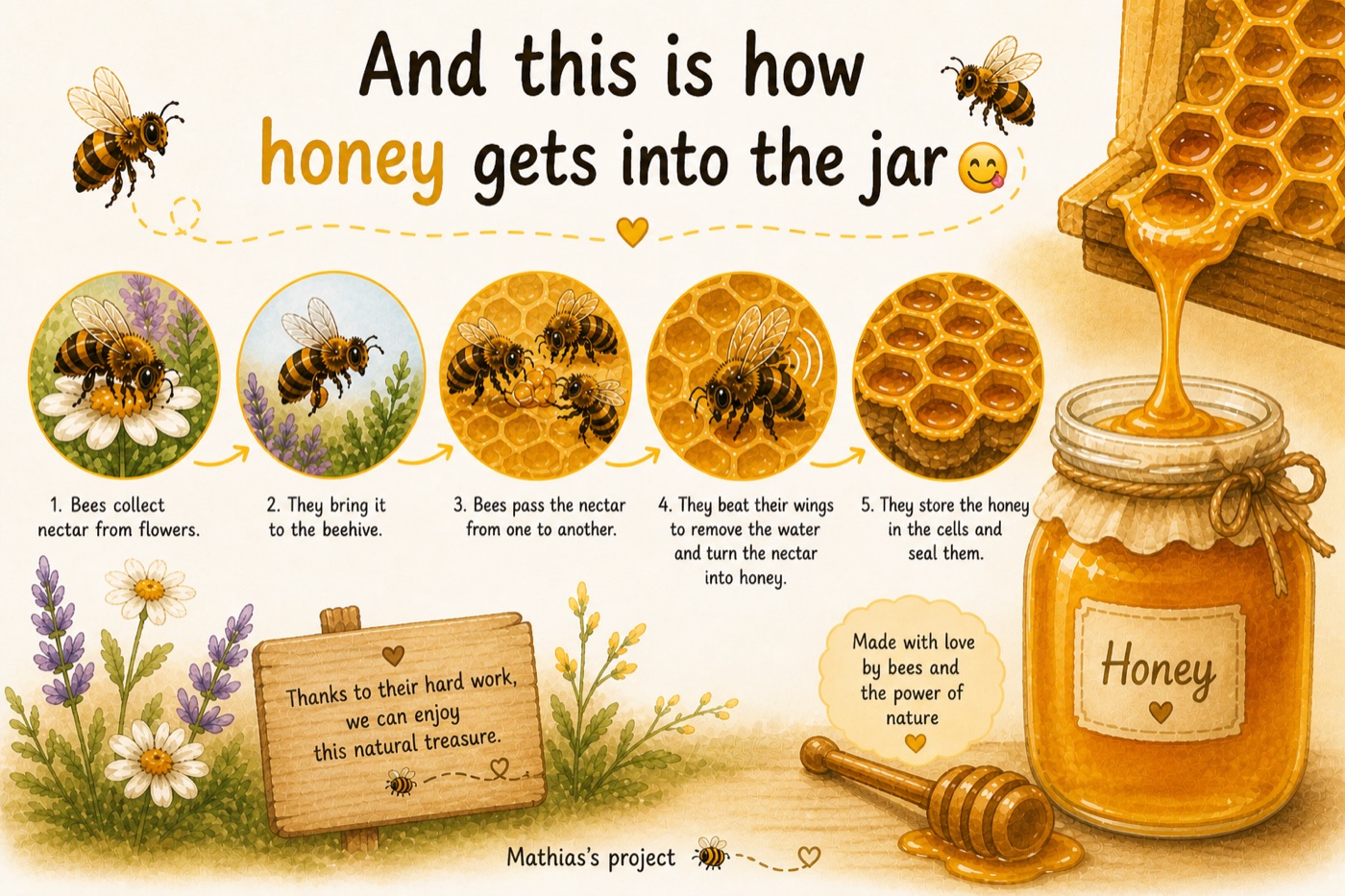
Here is that journey, in five steps, with drawings. Each step
is done by many bees together, all working with so much energy
and care.
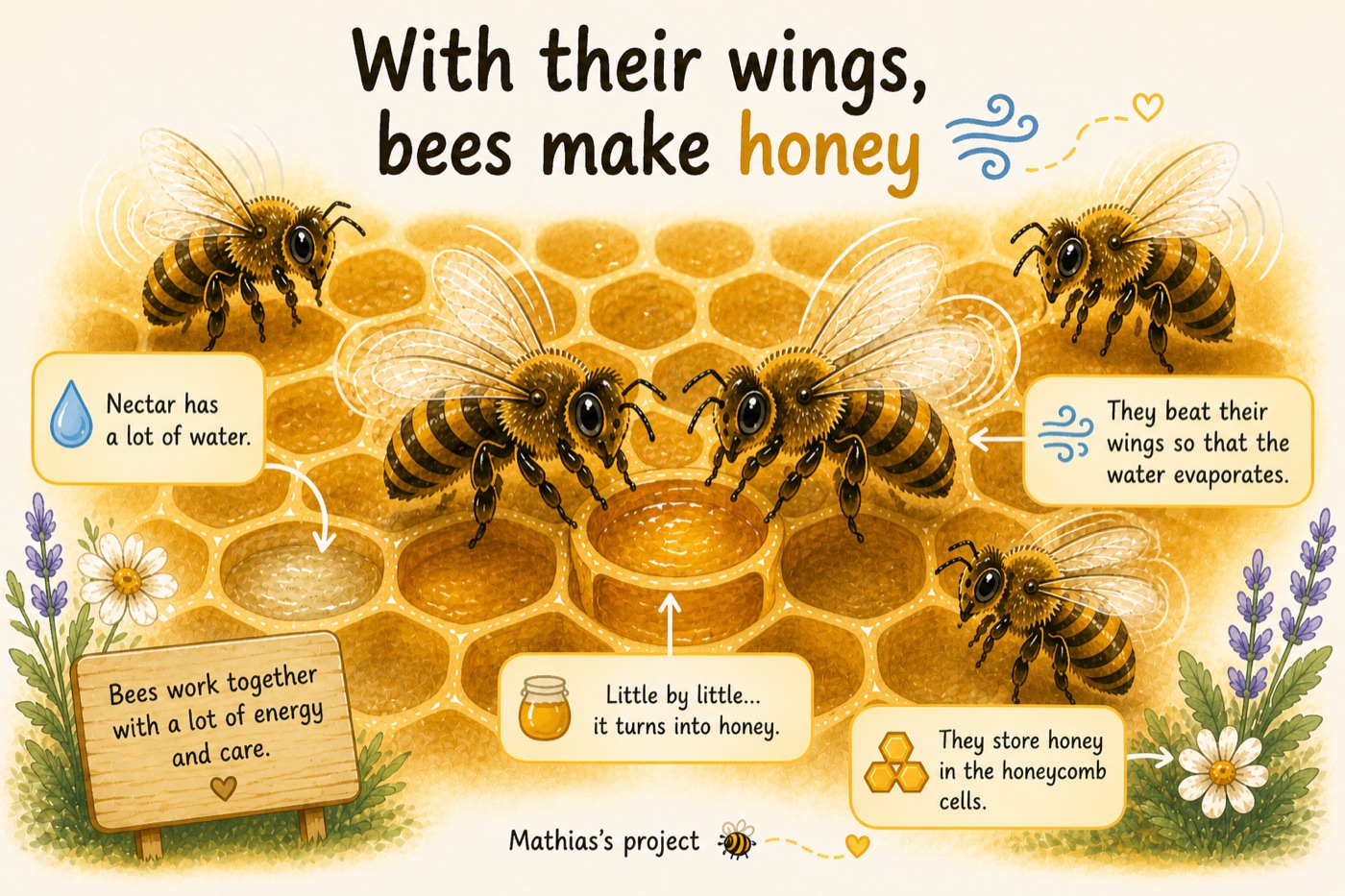
The bees beat their wings to dry the nectar. Slowly, the nectar becomes honey.
Nectar is very watery
When a bee gathers nectar from a flower, she is not gathering
honey yet. Nectar is very watery — full of water. To turn it
into honey, almost all of that water has to leave.
And here something beautiful happens. The bees line up inside
the hive and beat their wings, all together, for days. They
move so much air that the water slowly evaporates. It is a
fan made of a thousand bees.
Honey is never made by one bee alone.
It is made by many, mouth to mouth,
until it is finally ready.
When it is ready, they seal it
When the nectar has lost most of its water and has become honey,
the bees seal the cell with a thin lid of pale wax. The honey is
kept safe, and it will not spoil. A sealed comb, held to the light,
looks like a row of tiny golden windows.
Made with love, by the bees and by the wild.
The five steps of the journey
The bees gather nectar — they fly from flower to flower, and store it in a special pouch inside their body.
They carry it back to the hive — and they bring pollen too, stuck to their tiny legs.
They pass it from one to another — mouth to mouth, each bee adds a little something.
They beat their wings — moving the air so the water in the nectar slowly evaporates and turns into honey.
They store the honey and seal it — with a thin lid of wax, ready for winter, or for us.
We only take what they can spare
This matters most to me: we never take all of the honey. The bees
need a great deal of it to live through the winter. We only take
what they have made on top — what is left over after we have
thought of them first.
So in dry years, or in years when the wildflowers are few, we take
almost nothing. In good years, a little more. But the bees always
eat before we do. That is the rule.
Each honey tastes of a place
If you taste honey slowly, you can tell where it is from.
Our rosemary honey — the one from La Canalosa — is pale and gentle.
Orange-blossom honey, from the citrus trees, is floral and almost
perfumed. Mountain honey, from the wild thyme and herbs, is
darker and stronger.
Each jar keeps the taste of a place, a spring, a wind. So a jar
of honey is like a postcard from the countryside: a small piece
of May, kept safely until December.
Questions people ask me
How long does it take to make honey?
From the moment a bee gathers nectar until the honey is sealed in the cell, two or three weeks pass. A single bee, in her whole life (about six weeks), only makes one small spoonful of honey.
Why does honey have different flavours?
Because each honey keeps the taste of the flowers the bees worked. Rosemary honey is pale and mild. Orange-blossom honey is floral. Mountain honey, with wild thyme, is darker and stronger. It is like tasting the whole landscape!
Does honey go bad?
Pure honey almost never goes bad. It can last for many, many years. Sometimes it goes solid and pale — that is called crystallising and is perfectly normal. Just place the jar in warm water (not hot) and it will become liquid again.
How much honey does a hive give in a year?
A healthy hive in a good year can give between 15 and 30 kilos. But we only take what they can spare — their winter food always stays in the hive. Some years we take almost nothing at all, and that is fine too.